The Other Red Meat
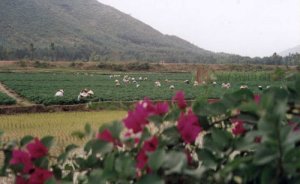 Lovingly hand cutlivated in the secret remote beet fields near Kobe, Japan, the legendary
Kobe Beet is one of Earth's rare culinary delicacies. The texture of the succulent flesh
is so fine and tender as to defy description.
Lovingly hand cutlivated in the secret remote beet fields near Kobe, Japan, the legendary
Kobe Beet is one of Earth's rare culinary delicacies. The texture of the succulent flesh
is so fine and tender as to defy description.
There are never more than ten beet fields planted in this region in any given year. The
seeds are sown in fields chosen by an ancient Buddhist ritual.
The location of the fields is known only to a select few, and these are sworn to secrecy upon
pain of death.
[note: The person who shot this picture escaped capture with only
seconds to spare.]
The beet farmers of Kobe dedicate their lives to nurturing these prized
vegetables. The leaves are brushed daily with sake, applied with a brush crafted of the finest
butterfly antennae. The attendants recite classic haiku to the plants to soothe
them as they hand massage the delicate shoots to hardy maturity. They are not given water
for moisture. Rather, they are sprinkled with Japanese Asahi beer five times every day.
Each plant is given daily acupuncture treatments to release toxins and reduce stress
during the last weeks before harvest.
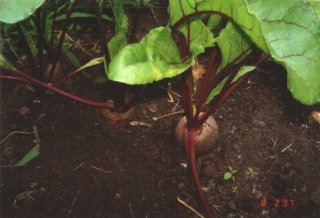 These "Treasures Of The Earth", as they are called in Japanese, are so rare and so
delicious that some dedicated epicures engage in a lifelong quest for a mere taste. Even
people who are avid carnivores have been known to be converted to Vegetarianism after
just one Kobe Beet dining experience.
These "Treasures Of The Earth", as they are called in Japanese, are so rare and so
delicious that some dedicated epicures engage in a lifelong quest for a mere taste. Even
people who are avid carnivores have been known to be converted to Vegetarianism after
just one Kobe Beet dining experience.
Despite the astronomical cost of this nearly unattainable ambrosia, I decided recently to
sample the Kobe legend for myself. I had saved for this for over ten years and had accumulated
enough money to purchase just seven Kobe Beets. At a cost of over $300 per ounce this came
to just under $10,000 - my entire life savings - but I knew this once in a lifetime meal
would be worth it.
Ordering the beets was no easy matter. The deal had to be cleared with the Japanese ambassador,
who set up the purchase through a Buddhist monastery. Finally the payment was made and my
order was reserved.
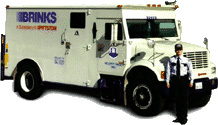 Nearly six months later I received a phone call announcing that the shipment would be delivered the next
 day. The Kobe people had arranged for the final delivery to be made by Brinks, Inc.
in order to assure that the priceless cargo would come to no harm. An armed guard handed the
beets over only after I passed a sophisticated fingerprint and iris identification
procedure.
day. The Kobe people had arranged for the final delivery to be made by Brinks, Inc.
in order to assure that the priceless cargo would come to no harm. An armed guard handed the
beets over only after I passed a sophisticated fingerprint and iris identification
procedure.
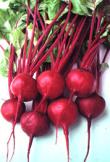 Finally I had the Kobe treasures in my possession. Only seven beets, but what magnificent
specimens! I had big plans for these roots.
Finally I had the Kobe treasures in my possession. Only seven beets, but what magnificent
specimens! I had big plans for these roots.
The first thing I noticed was the unbelievable smoothness of the outer peel and the firm,
yet uniformly delicate texture of each glowing globe.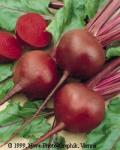 I can't remember being in the presence of a vegetable that held such promise. The undivided
attention of the Kobe monks had done its magic.
I can't remember being in the presence of a vegetable that held such promise. The undivided
attention of the Kobe monks had done its magic.
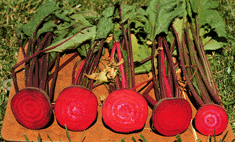 Now it was time to prepare the feast. The first order of business was to
separate the prized roots from the luxuriant leaves. This had to be done with the
greatest care, using only the sharpest Ginsu knife. Even the slightest bruise would diminish
the pleasure my taste buds were anticipating. My plan was to expose the miracles of Kobe
to superheated steam for only a few seconds, then plunge them into icewater to stop the
cooking process at precisely the most opportune moment. This was a game of microseconds. The
slightest miscalculation could overcook the beets and transform the Kobe dream to a nightmare.
Now it was time to prepare the feast. The first order of business was to
separate the prized roots from the luxuriant leaves. This had to be done with the
greatest care, using only the sharpest Ginsu knife. Even the slightest bruise would diminish
the pleasure my taste buds were anticipating. My plan was to expose the miracles of Kobe
to superheated steam for only a few seconds, then plunge them into icewater to stop the
cooking process at precisely the most opportune moment. This was a game of microseconds. The
slightest miscalculation could overcook the beets and transform the Kobe dream to a nightmare.
After reserving one beet to be used for a sashimi style raw appetizer I plunged the rest
of the bunch into the preheated steamer. The 54 second cooking cycle was timed with surgical
precision, using my Radio Shack ® digital timer. The icewater
cooled the veggies before any of the flavor or nutrients could be lost. They were perfect.
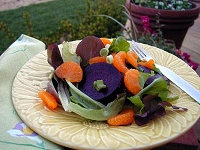 The preparation was simple. I wanted to make sure not to distract from the beets' intrinsic
Kobe-ness. The raw beet was presented on a bed of greens, with a subtle
rice vinegar dressing that perfectly framed the sweet flavor and smooth texture of the flesh.
Garnished with a few perfect slices of Mandarin orange, the blend of textures, color and
flavor was to die for. No other raw vegetable could compare. One of the most striking things
about this amazing beet is that it holds its juice. Unlike other beet varieties that "take
over" your plate, staining every food in its vicinity with vivid red juice, the Kobe Beet
keeps to itself, allowing other veggies and fruits equal time. It is a vegetable that is
unassuming in its confidence.
The preparation was simple. I wanted to make sure not to distract from the beets' intrinsic
Kobe-ness. The raw beet was presented on a bed of greens, with a subtle
rice vinegar dressing that perfectly framed the sweet flavor and smooth texture of the flesh.
Garnished with a few perfect slices of Mandarin orange, the blend of textures, color and
flavor was to die for. No other raw vegetable could compare. One of the most striking things
about this amazing beet is that it holds its juice. Unlike other beet varieties that "take
over" your plate, staining every food in its vicinity with vivid red juice, the Kobe Beet
keeps to itself, allowing other veggies and fruits equal time. It is a vegetable that is
unassuming in its confidence.
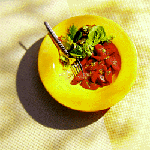 And now for the piece de resistance. The ever so slightly steamed beet halves were
sliced wafer thin and served with a delicate mild mustard sauce on the side. One drop of this
exquisitely subtle sauce would be enough to support the unique Kobe flavor. The color of the
steamed Kobes was remarkably vibrant, without being overpowering. The hue was regal, rather
than the blood red associated with normal beets. And again, there was no "bleeding" onto the
plate. The flavor was rich and subtle, with none of the strong "vegetable" flavor one might
expect. The texture was firm enough to the bite to be satisfying, yet each forkful seemed to
melt into a rainbow of flavor. Amazing. After fully half an hour of rhapsodizing over this
dining experience of a lifetime, we cleared our palates with a few spoonfuls of orange
sherbet, which echoed the flavors of the first course masterfully.
And now for the piece de resistance. The ever so slightly steamed beet halves were
sliced wafer thin and served with a delicate mild mustard sauce on the side. One drop of this
exquisitely subtle sauce would be enough to support the unique Kobe flavor. The color of the
steamed Kobes was remarkably vibrant, without being overpowering. The hue was regal, rather
than the blood red associated with normal beets. And again, there was no "bleeding" onto the
plate. The flavor was rich and subtle, with none of the strong "vegetable" flavor one might
expect. The texture was firm enough to the bite to be satisfying, yet each forkful seemed to
melt into a rainbow of flavor. Amazing. After fully half an hour of rhapsodizing over this
dining experience of a lifetime, we cleared our palates with a few spoonfuls of orange
sherbet, which echoed the flavors of the first course masterfully.
Basking in the memory of this one of a kind dining experience, I can say without reservation
that this was worth squandering the security of my old age. Sure I have to start over again
with my savings, but how often does one have a chance to eat a vegetable that costs as much
as a decent vehicle?
The Holy Grail
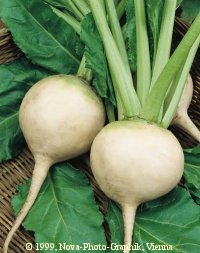 But the Kobe is not the ultimate in Beet-dom. The Holy Grail of beet connoisseurs is the fabled
Matsuzaka Beet. An albino beet of unrivaled sweetness and texture, this revered vegetable has
never crossed the taste buds of Western diners. Grown in fields known only to the Emperor
of Japan, the Matsuzaka is so rare and so coveted that only Bill Gates could hope to
experience it. But even all his wealth and his wily, unscrupulous ways are not enough to
bring this wondrous gift to his table. Still, this is a moot point, since it's well
documented that Gates hates vegetables.
But the Kobe is not the ultimate in Beet-dom. The Holy Grail of beet connoisseurs is the fabled
Matsuzaka Beet. An albino beet of unrivaled sweetness and texture, this revered vegetable has
never crossed the taste buds of Western diners. Grown in fields known only to the Emperor
of Japan, the Matsuzaka is so rare and so coveted that only Bill Gates could hope to
experience it. But even all his wealth and his wily, unscrupulous ways are not enough to
bring this wondrous gift to his table. Still, this is a moot point, since it's well
documented that Gates hates vegetables.
But I digress. It is rumored that the Matsuzaka was originally cultivated by Kamikaze pilots
during the war as a way to relax and ease the unimaginable tension of their lives. They lavished all the
attention of the Kobe caretakers and more, and the beets were only harvested after they completed
their deadly mission. In modern times, the Matsuzaka beet farmers are required to commit
Hara-kiri on the small plots as a final sacrifice just prior to harvest. Ah - perhaps
I'll experience this rare culinary treasure in another lifetime.
Related Links
© Roger Brotherhood, 2000
|